


Longevity pays off, but how do you really extend it?
The added value of a long longevity is undisputed. Genetics form an important foundation in this. Without the right genetic predisposition, it is almost impossible to reach five lactations. However, genetics are not the only factor that matters. Good management, with attention to health, nutrition, and young stock rearing, is at least just as important to allow cows to grow old in a sustainable way.
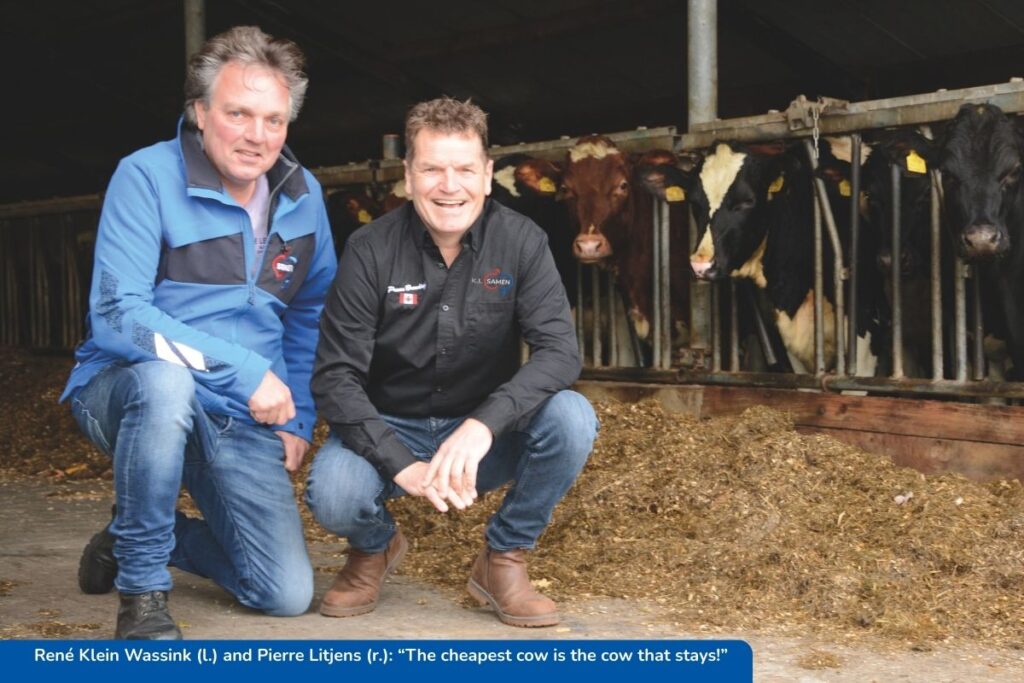
Making a conscious choice for longevity
Breeding adviser René Klein Wassink has been working at K.I. Samen in the Netherlands for more than thirty years and visits many dairy farms where the focus is on longevity. René explains: “On farms that actively breed for longevity, you often see a remarkably uniform herd: cows with a balanced build, strong legs, and healthy claws. These farmers focus on functionality and durability and are less guided by bulls with the highest breeding values. They usually use the Triple A system as a tool to steer their breeding in a targeted way. They consciously choose cows that last a long time and perform without problems year after year.”
Long live the wallet
Pierre Litjens also explains that longevity of dairy cows directly results in financial benefits. Pierre has worked for more than ten years as a breeding adviser at K.I. Samen, represents several federal states in Germany and Austria, and is sales manager in Canada. “When cows get older, fewer young stock are needed for replacement,” he explains. “This reduces rearing costs. Farmers who keep fewer young stock can also milk more cows. With late maturing animals that can grow old, the highest production usually comes after the fourth lactation.”
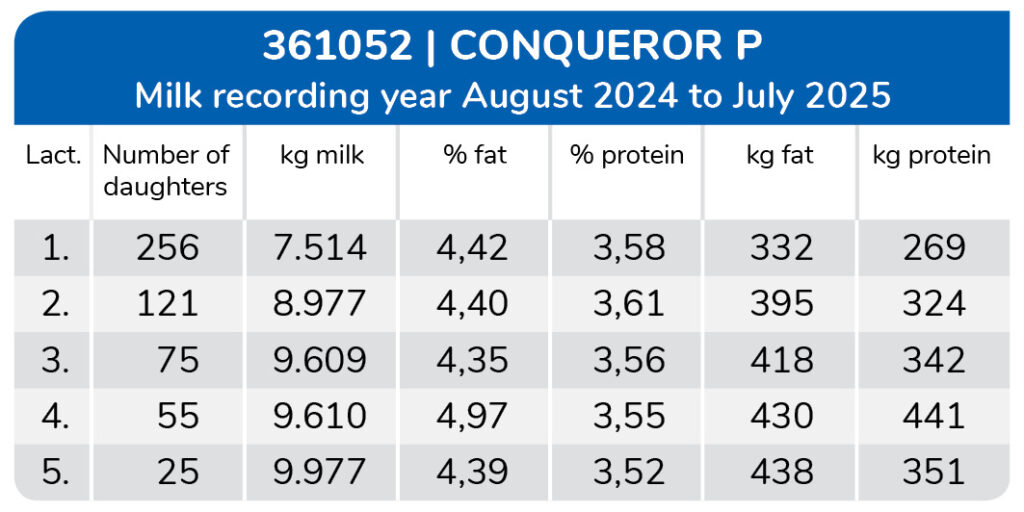
Attention to rearing
“You do not get an older herd overnight,” Pierre emphasises. “Anyone who wants to extend the longevity of the herd must ensure good management, starting with proper rearing. Everything you miss in the first nine months can never be recovered. From birth, you must stay on top of it. In the first development stage, the calf must grow well; nutrition and health are the main focus points. Immediately after birth, the calf receives colostrum for sufficient resistance. In addition, ensure hygiene in the calving area and clean individual calf pens.”
Inseminating at the right time
“A heifer is preferably inseminated between 13 and 15 months,” Pierre explains. “This way, they calve for the first time by the age of two at the latest. When they are inseminated later, they often become too fat. This delays conception and costs the farmer income.”
Avoid early maturity
René adds: “Anyone who wants to work on longer longevity must pay attention to late maturity. Early maturity for production should be avoided. Let a heifer develop calmly into a mature cow. A heifer may be ‘in the ground’ or ‘on the head’, however you want to describe it, but she must ‘break’ at a later age. Such heifers often start with 82 or 83 points and grow to 86 or 87 points at four or five years of age. Large, very open heifers with 86 points or more rarely improve at an older age.”


Avoid extreme bulls
Not only the late maturity of the cow, but also that of the bull is crucial. “With proven bulls that score high for late maturity and longevity, you can easily breed cows that stay productive for a long time,” says René. “Also avoid extreme bulls. Pay attention to stature, rump structure, and rear leg side view. For example, our bulls Drouner Potency Red P, Poppe Kayne, and VDR Slash show favourable figures for these traits. Do not choose bulls with a stature above 110 and a rump structure of 90 or lower.”
.
Anyone who wants to work on longer longevity must pay attention to late maturity. Grashoek Mareno scores 108 for late maturity.


The right mating combinations
Why does it sometimes still fail to extend longevity? “Using the same aAa code generation after generation does not promote longevity,” René states clearly. “It may be genetically present, but if the mating is not correct, it will not come through. So do not continuously use the same code and do not only look at the NVI. The right mating combinations are essential. In a balanced pedigree, all numbers appear in the first two generations. The bull must not only have the right sire line, but also the correct order of aAa codes.”

Selestine 4: 1st lactation: age 2.00 | 9,797 kg milk | 4.83% fat | 3.92% protein | LV 116+
Photo explanation: The pedigree Wishlist aAa 423 × Slash aAa 153 × Eragon aAa 216 is a good combination for breeding longevity. Selestine 4 is now in calf to Styles aAa 153.
Proven cow families with sustainable performance
K.I. Samen supports dairy farmers in making the right genetic choices to breed well balanced, problem free cows. This is done with bulls from proven cow families with strong pedigrees and sustainable performance. An example is VDR Styles (Ginstream × Martin × Bandaris × Malki × Minos) from the Sandra cow family. Pierre adds: “Valor Tobor (Topgear × Commander × Beacon) also comes from a strong cow family. He was bred on a farm that has worked with the Triple A system for many years. Tobor excels with a longevity score of 529 and excellent claw health of 109.”
Healthy claws, healthy cows
“Claw problems are often mentioned as one of the main obstacles to a long longevity,” Pierre continues. “They are a common reason why cows do not age without problems. That is why attention to claw health is essential. Use bulls with good claw health, such as Valor Tobor (109) or VDR Slash (107). In addition, good claw care remains indispensable: timely trimming, regular footbaths, and clean bedding help keep claws healthy.”
Good feeling, good reputation
“A longer longevity does not only deliver financial benefits,” Pierre concludes. “For many dairy farmers, it is satisfying to have older, vital cows in the barn. Their presence shows that good management and care go hand in hand with animal welfare and with a positive image of the sector.”
Summary
- Longer longevity pays off:
– lower rearing costs,
– higher production,
– better animal welfare. - Genetics are the foundation, management is the key: nutrition, health, and rearing determine success.
- A good start is crucial: from birth, focus on growth, nutrition, and timely first insemination.
- Avoid early maturity for production: let a heifer develop calmly into a mature cow.
- Breed for functionality: make sustainable matings using a tool such as the Triple A system.
- Avoid extremes: choose late maturing cows and bulls with balanced figures for stature, fertility, and rump structure.
- Healthy claws extend longevity: select bulls with good claw health and ensure optimal care and hygiene.