


Balance in the barn proves itself every day
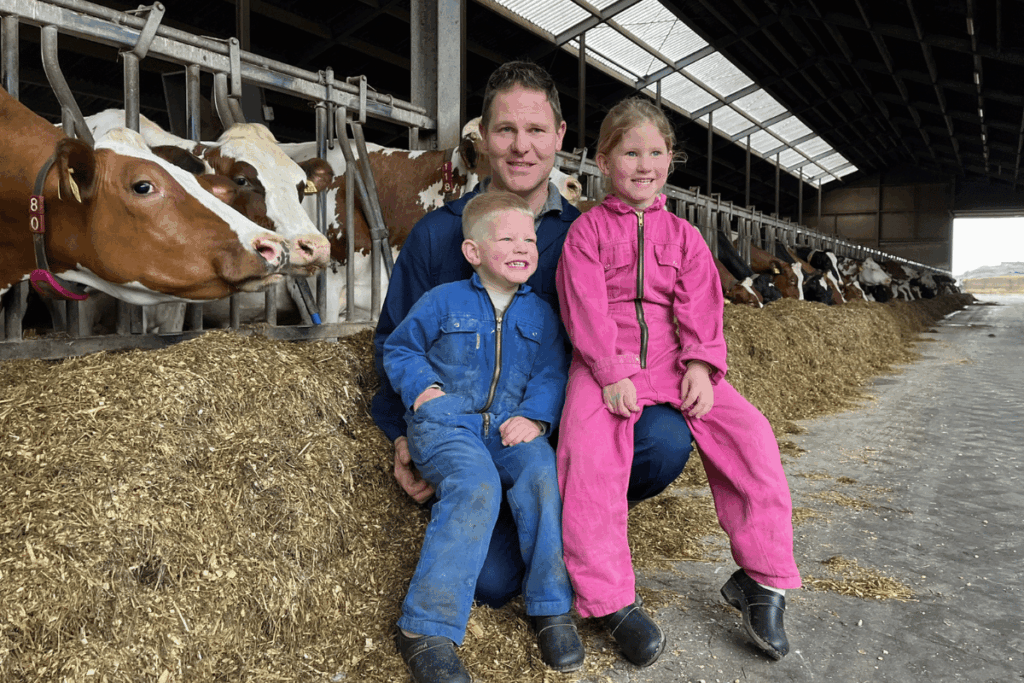
Anyone who enters the barn at dairy farm Van Delft in Elshout (NL) notices it straight away: there is calm here. Cows eat quietly at the feed fence or lie ruminating in the cubicles. What stands out most is the uniformity of the herd. These are not cows that attract attention, and that is exactly their strength. Here, everything is about balance. Balance in the cow, in the herd and in breeding.
Functional cows
Together with his father Rini and brother Leo, Arno van Delft runs the family farm with 200 dairy cows. “We do not want extremes, but well-built functional cows that simply do a good job,” says Arno in a down-to-earth way. This breeding vision is also reflected in the figures. Last year, the farm produced an average of 10,600 kilograms of milk with 4.55% fat and 3.69% protein. But for Arno, those figures do not say everything. “It is about cows taking in a lot of roughage, so they stay healthy and last for several lactations, giving a good margin.”
Rooted in generations
The farm has a long history. Grandfather Van Delft once started with three dairy cows, combined with horticulture. His son Rini developed the farm further, and today the third generation is in charge. Meanwhile, the fourth generation is already growing up among the cows. In 2016, the barn was extended, and in 2019 three milking robots were installed. Besides his work on the farm, Arno has been an inseminator at K.I. Samen for eighteen years. Three days a week he is on the road visiting fellow farmers. “You see many farms and many cows. That helps you stay critical in your own breeding.”
Breeding from the cow
The calm in the barn is no coincidence, but the result of clear choices. For Arno, everything starts with breeding a balanced cow. He looks at the cow: what is missing in her conformation? And which bull can correct this in the next generation? “A well-balanced cow is medium-sized, but wide enough. With a deep rib, a wide front end and a wide muzzle, so she can process a lot of roughage,” he explains. The rump also plays an important role. “That must be correct, so she can calve easily and start up again quickly.”
Practical approach
From that approach, he selects the bull. The idea behind the Triple A system plays an important role in this. Arno continues: “For example, when a cow needs more strength or dairy type, I choose a sire with the right aAa code to improve that.” Only after that does he look at the breeding values. According to him, the difference between figures on paper and practice is clear. “You can have everything perfect on paper, but in the end it has to happen in the barn.”
.
“Better a good cow in the barn than one that only looks good on paper.”
– ARNO VAN DELFT – DAIRY FARM VAN DELFT, ELSHOUT (NL) –
.
K.I. Samen genetics
This way of working fits perfectly with the philosophy of K.I. Samen. The cooperation goes back several decades, and today more than 95% of the genetics come from K.I. Samen. The first bulls used, such as Thunder van der Wilg and Lightning rf, laid the foundation. But Malando in particular left his mark on the herd. “We regularly use young bulls because we trust the strong cow families behind the sires. At the moment, several heifers by Aiden Red are calving, and calves are being born by, among others, Ritchy Red and Keylon Red P, and soon by Carambole Red. Current proven bulls such as Abraxas Red P and Musthave Red were used a lot by us as young bulls.” However, not all cows are used for breeding. “About thirty percent are inseminated with Belgian Blue. We mainly use Beer on younger animals and Jordy on older animals,” says Arno.
The strength of cow families
What Arno is most enthusiastic about are cow families in which several, three, generations in a row have produced at least 80,000 litres with good components and a good residual value. A good example is Lies 64, an Outlaw daughter from a Malando dam. She is now in her seventh lactation and has already produced over 88,000 litres of milk with 4.85% fat and 3.68% protein. Irma 75 (Moneymaker x Malando) is now in her fifth lactation and has produced over 70,000 litres with 4.13% fat and 3.70% protein. “They are simply well-built cows that are in balance and show in practice that they easily last for several lactations.” In addition, the Pieta family, with around 60 animals, is the largest cow family on the farm. “They are wide cows that stay in good condition. Pieta 168 by Abraxas Red P is a good example. As a heifer, she produced 10,551 litres in 316 days with 4.19% fat and 3.66% protein, while maintaining condition.”
.

Longevity as a measure
Good results have also been achieved in longevity. The farm has now produced six cows with more than 100,000 kilograms of milk. Two of them are still in the barn. Each year, several cows are sold to fellow farmers because the culling rate is lower than the number of youngstock coming in. This also contributes to a good margin and confidence in the breeding.
Proud of a uniform group
The breeding strategy perhaps comes together best in the daughters of Abraxas Red P. There are now 17 in milk. In 2025, six of them were photographed together. For the family, this was a special moment: a fine group of heifers by a young bull, producing well, with strong legs, enough width and a pleasant character.
.

.
Practical proven breeding!
“You do not recognize good cows by figures alone, but by how they function every day. Cows that produce without problems, stay healthy and require little work. Those are the cows you can build on.” That is exactly the daily practice at dairy farm Van Delft. The results in the barn confirm again and again the confidence in the genetics of K.I. Samen. As Arno says himself: “When you see cows like these walking around, you know that practical proven breeding works.”
FARM PROFILE
- Farm: Melkveebedrijf van Delft VOF, Elshout (NL).
- Land in use : 115 ha, 30 ha of maize en 85 ha of grassland.
- Herd: 200 cows and 120 head of young stock.
- Average production : 10.600 liter | 4,55 % fat| 3,69 % protein.
.
