


Balance as the foundation, practice as the proof
The breeding philosophy of K.I. Samen is based on one clear belief: success is not determined by figures on paper, but by performance in the barn. By selecting from proven cow families and sire lines, and by focusing on balance, functionality and longevity, K.I. Samen has been building cows for decades that produce without problems and contribute to healthy farm returns. Breeding advisers Jan Wagemaker and Uwe Allers see every day how this philosophy works in practice on dairy farms.
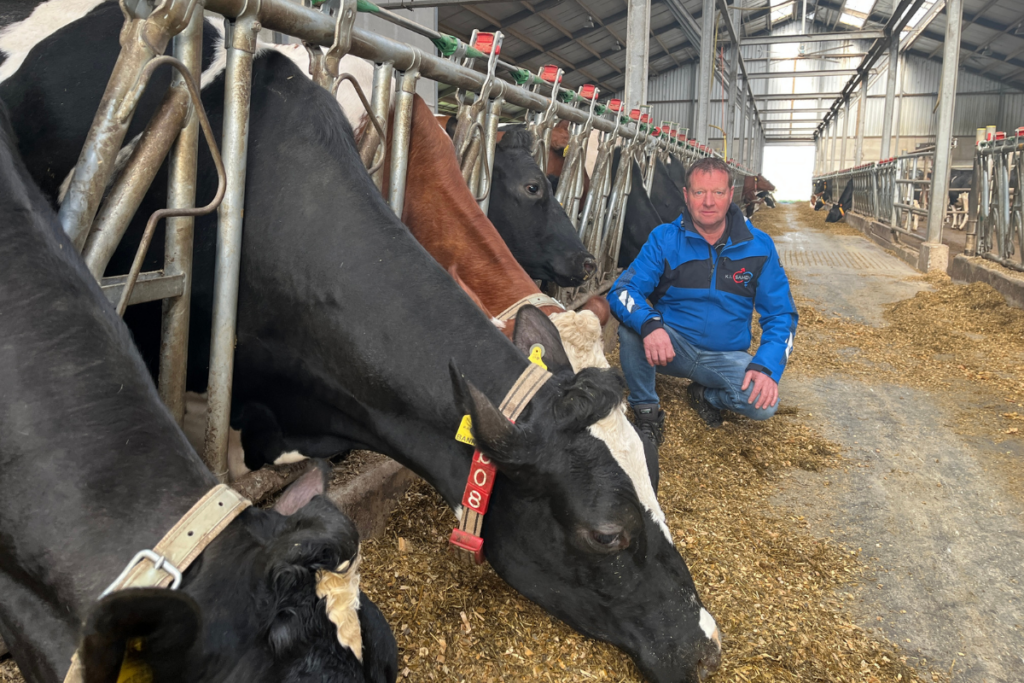
The cow as the starting point of breeding
Jan Wagemaker has been working at K.I. Samen for more than thirty years and visits dairy farms in North Holland, often for three generations. He sees up close how breeding choices develop in the barn. “What makes our philosophy special is that we always look at the cow,” says Jan. “We think about how we can improve the next generation, not just about figures.” Uwe Allers adds from his work area in northern Lower Saxony in Germany, where he has been advising dairy farmers for five years. “In addition, our bulls often have a different transmitting ability,” he explains. “They help bring cows back into balance and, through their pedigree, also provide more genetic variation.”
Reliability through proven genetics
Although German dairy farms can differ greatly, Uwe sees a clear similarity. “On one point, farms agree: the cow must function within their system,” he says. “More and more farmers value the reliability of bulls from proven cow families and their daughters that prove themselves in practice.” According to him, recognisability plays an important role. “Farmers want to work with clear and easy to understand information. For many people, genomic breeding values are quite abstract. The dam performance of young bulls and the daughter performance of daughter proven bulls are figures from practice. That gives farmers more certainty in their breeding choices and a clearer picture of what to expect.”
“When you breed for balance, you get a cow that functions better and can maintain that for a long time.”
Moving away from extreme breeding
Jan warns that the sector sometimes goes too far towards extremes. “We need to move away from one sided breeding,” he says. “Extremely large cows may produce well, but often do not last long.” Uwe recognises this in his region as well. “Many farmers experience that cows are becoming larger and narrower,” he explains. “Also the trend towards steeper rear legs is getting more criticism. These are developments that can reduce durability and workability.” According to him, this is exactly where the philosophy of K.I. Samen fits well. “When you breed for balance, you get a cow that functions better and can maintain that for a long time.”

Problems farmers recognise
When farms start working with K.I. Samen, Uwe often notices cows that are too large, too narrow or too steep in structure. “These are animals that are often more vulnerable. Many of these farmers can use the genetics of K.I. Samen to bring more balance into their herd. They want a more problem free and functional herd,” explains Allers. “In such situations, bulls with aAa codes such as 156, 516 and 615 often work very well.”
Uniformity brings calm in the barn
Jan sees the same development. “In the past, you often saw a lot of variation: large, narrow and extreme cows mixed together,” he says. “Nowadays I see more uniformity in herds. Cows are slightly smaller and better balanced, and therefore healthier.” According to him, this is because farmers think more consciously about their breeding goal. “They see that balance leads to fewer problems, higher productivity and better returns.” Uwe sees the same effect on farms that have been working with K.I. Samen bulls for a longer time. “These herds are clearly more uniform,” he says. “The cows are more harmonious in structure, because dairy type and strength are better balanced. As a result, they can produce well and also reach a higher longevity.”

Sustainable production starts with the heifer
“The effects of this approach are visible at an early stage. You can even see it in the calves,” explains Uwe. “The animals often develop more calmly.” According to him, this later maturity has advantages. “As heifers, they may start a bit slower, but they last longer. In later lactations, they have no problem achieving very high milk production.”
What drives the dairy farmer of tomorrow
According to Jan, the mindset of dairy farmers is also changing. “The future farmer chooses ease and reliability,” he says. “They want a uniform, healthy and problem free herd.” In the past, extreme cows often attracted attention. “But those animals often had the most problems,” Jan explains. “When form and function are in balance, cows do not stand out. And those are exactly the cows that form the strength of a dairy farm, because they are easy to manage and cause few problems.” Uwe agrees: “In addition, I see that the requirements for dairy cows in Germany are becoming more complex. The cow must produce a lot, while veterinary and replacement costs must stay low. Also, the use of milking robots is increasing, so the cow must function well in that system.”
Targeted mating with the Triple A system
To breed in a targeted way, more and more farmers use tools such as the Triple A system. According to Jan, this helps to make focused decisions. “Farmers no longer simply choose the highest bull on paper,” he says. “They look at what the cow is missing in her structure and make a targeted mating using the aAa method.” According to him, this approach directly contributes to better balance in the body structure of the animal.
Growing use of the aAa method
In the Netherlands, the Triple A system has been used for a long time, but interest is also growing in Germany. Uwe sees a clear development. “The number of farms using it is increasing, because the simplicity of the system appeals to farmers,” he says. “The principle is clear: the structure of the cow and the bull must complement each other. By focusing on balance, you create a stronger foundation.”
The ideal cow
When Jan is asked about his ideal cow, he immediately returns to the word balance. “For me, the ideal cow is complete and functional: not too large, well balanced and with strong legs,” he says. He focuses on sustainable performance. “I like to see a rising production line and healthy cows that last for multiple lactations. Preferably late maturing heifers that develop calmly and peak later, because it is not about fast production but about longevity.” Uwe agrees and describes the ideal cow as a medium sized animal with a feminine head and a wide muzzle. “The chest must be wide and deep so the organs have enough space, with open ribs to support production.” He also finds the rump important. “It must be wide, so calving goes smoothly and it provides a good base for a wide udder.” In addition, he pays attention to legs and claw health, and the udder must be functional. “A long, strongly attached udder, a strong suspensory ligament and centrally placed teats complete the picture.”

Targeted choices instead of only figures
According to Uwe, good breeding starts with analysing the individual animal. “You should not only look at high breeding values,” he says. “You should mainly look at what the individual cow needs.” He warns that one sided selection brings risks. “If you only look at high index figures without considering what the cow is missing in her structure, you get more extreme and vulnerable cows.” Therefore, breeding values should mainly be seen as a tool. “For your own breeding goal, you should look at which type of cow functions best within your own herd.”
More job satisfaction and better returns
Jan agrees and has a clear message for farmers. “A bull must fit the herd and the breeding goal,” he says. According to Jan, this practical approach not only affects the cows, but also the farmer. “The future of dairy farming lies in efficiency and sustainability,” he says. “Farmers want good returns with less labour and more job satisfaction.” Despite increasing regulations, he still sees a lot of enthusiasm in the sector. “There is still a lot of passion for the profession,” he says. “That proves that the practical approach works.”
More than forty years of proof
The result of this philosophy is visible on many dairy farms, both in the Netherlands and abroad. Farmers experience every day that balanced breeding leads to strong, durable cows. In the end, one conclusion remains: when cows produce without problems and last for multiple lactations, practice speaks for itself. “And we are proud of that: for more than forty years we can say that the practice proves it.”