


How do you improve your herd for the future?
Inbreeding is increasing worldwide because the same popular bloodlines are being used more and more intensively. Although genetic progress may seem to move faster because of this, inbreeding leads to an increase in hereditary defects, both visible and invisible. How do you keep your herd future-proof? The members of K.I. Samen’s Breeding Committee explain how they deliberately focus on bloodline diversity when selecting new bulls. By paying particular attention to strong cow families, both well-known and less well-known, K.I. Samen creates room for sustainable progress in breeding.
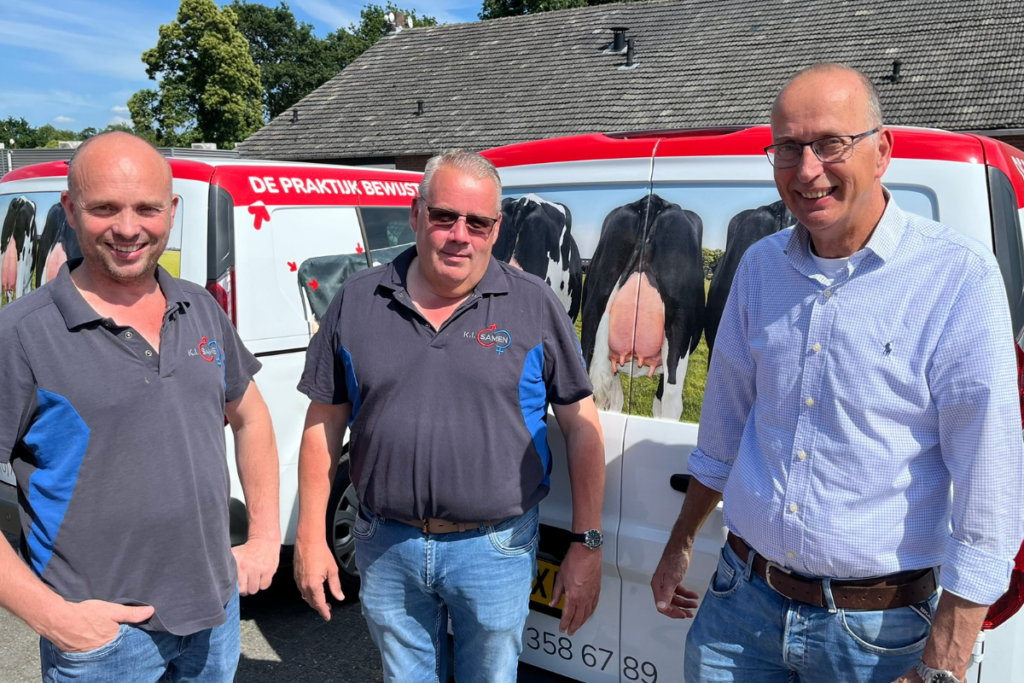
About inbreeding, outcross and the strength of different bloodlines.
Breeding Committee
Ralph Engelen, Hans Wargerink and Gerard Scheepens together form the K.I. Samen Breeding Committee. They are responsible for purchasing new bulls. The focus is on sires that breed trouble-free, high-producing cows with high components and a long productive life. Diversity in bloodlines is also an important point of attention, especially at a time when inbreeding is increasing worldwide.
Increasing inbreeding
“If you ask a dairy farmer today what he would most like to see, in most cases he will say that he wants a uniform herd with cows that easily produce plenty of milk and stay in the herd for a long time,” Ralph Engelen begins. “Reaching an old age without problems also means keeping the number of inbred animals as low as possible.” Gerard adds: “Inbred animals have shorter lives and cause more problems for both the dairy farmer and the cow.” Inbreeding occurs when related animals are mated. This increases the chance that the same gene variants are passed on to the calf by both parents. “Because many dairy farmers choose bulls with high genomic figures, the highest bulls in the rankings often also become the most popular bulls,” Hans explains. “Their bloodlines are used more intensively and this increases the inbreeding percentage. More and more of the same does not create variation.”
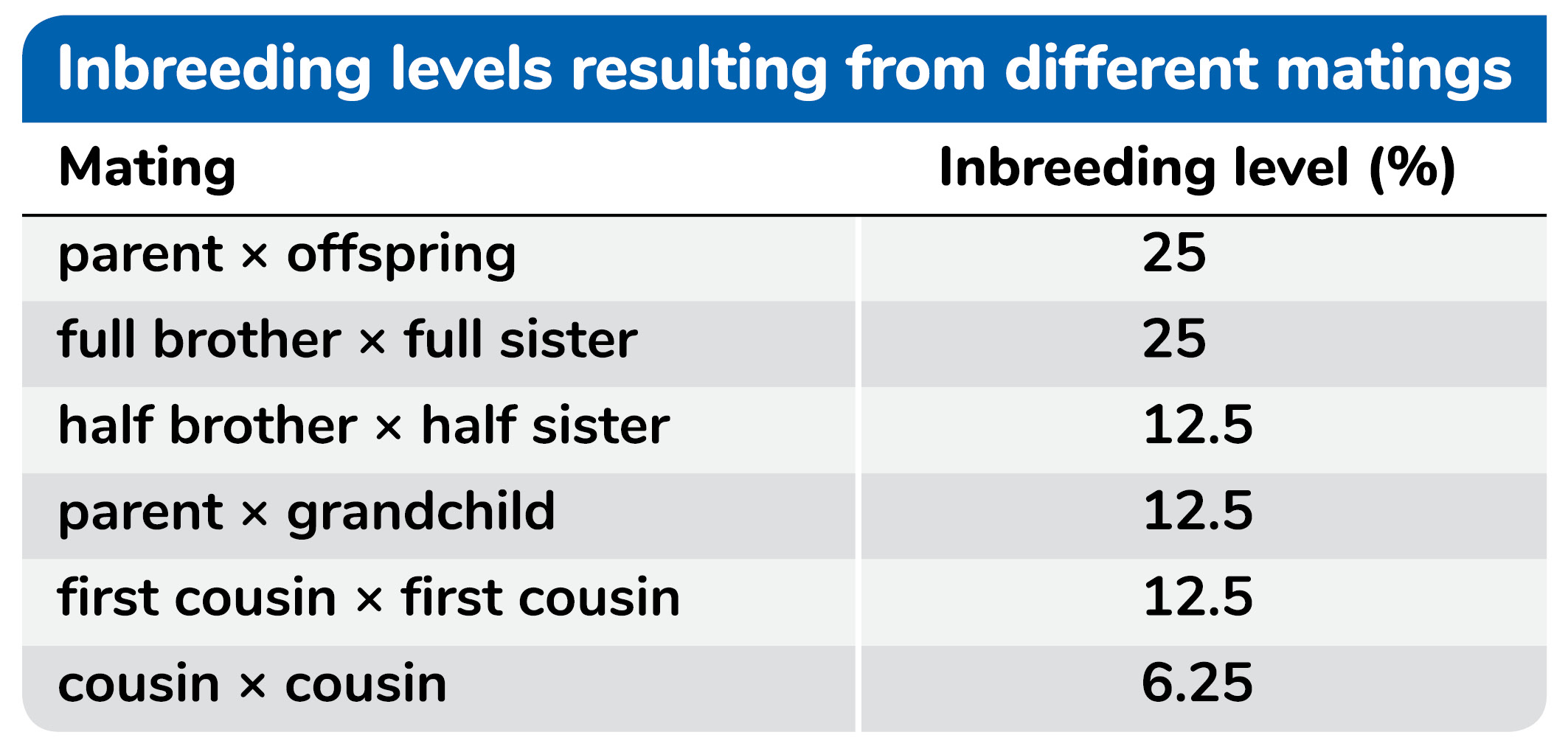
This increases the chance that the same gene variants are passed on to the calf by both parents.
Not the highest breeding value, but the best match
Inbreeding cannot be completely avoided within a closed breed. It is therefore important to keep the increase in inbreeding low. The FAO, the Food and Agriculture Organization of the United Nations, recommends limiting the increase in the level of inbreeding to a maximum of one percent per generation. For dairy farmers, it therefore remains important to consider variation in bloodlines when choosing a bull. “The best bull to use is not always the highest one, but the sire that best matches the cow. This also applies to bloodlines,” says Hans. “Try to optimise the conformation of the cow to breed a healthy, better functioning and trouble-free cow that lasts for many years.” “The level of inbreeding has now already risen well above the FAO standard of 1%. This causes problems for dairy farmers. In that situation, an outcross sire with a fresh bloodline has much more value for the population,” Gerard says.

Inbreeding depression
Ralph also sees risks in the longer term. “The frequent use of popular bulls can lead to hereditary defects. The higher the inbreeding percentage, the greater the risk of problems. As many as nine out of ten hereditary defects are caused by inbreeding that comes from the sire line. Hereditary defects are not always immediately visible, but they can certainly appear later in life.”

According to Hans, the consequences are often underestimated. “Inbreeding leads to inbreeding depression. This means that animals perform less well than you would expect based on their genetic potential. This can mean lower fertility, less resistance to disease, lower production and ultimately a shorter productive life.” Ralph adds: “Fertility is now one of the main reasons for culling. One result of inbreeding can be that a cow no longer becomes pregnant. You often only see this problem later in life. That is why diversity in bloodlines is so important for future generations of dairy cattle.”
“You have to be prepared to choose different bloodlines from time to time and not blindly follow the highest index.”
Sound conformation + qualities from the maternal line + outcross
When selecting new bulls, the Breeding Committee is right at the start of the process of maintaining genetic diversity. “First of all, a bull must have correct conformation, with form and function in balance,” Hans explains. “The sire must also add valuable qualities to the population through his maternal line, while we critically assess the sire line for bloodlines and relatedness. We avoid bulls with a very high inbreeding percentage. There are situations where a bull has remarkable breeding values on paper, but we still do not buy him because, in our view, his inbreeding percentage is too high.” Ralph continues: “The maternal line is the most important. The cow family must perform above average and score well for production and components.” Hans agrees: “Over several generations, a cow family must meet our requirements for production and conformation. We deliberately look beyond only the most popular cow families. At K.I. Samen, less well-known cow families also get a chance.” Examples he mentions are the Rozas, Anna Jacobas, Toosjes and the Anemoon line, which produced Red River and Red Ravello. These are cow families with high lifetime production that have ultimately proved to be very successful.
Deliberately breeding for the future with outcross
According to Ralph, this is also where the strength of outcross lies. “An outcross sire is a bull with a bloodline that is not widely present in the Dutch population at that time. These bulls can be very important for future generations. You have to be prepared to choose different bloodlines from time to time and not blindly follow the highest index.” Gerard agrees: “An outcross mating can be very interesting for the future. More diversity in bloodlines means there will still be enough room for genetic progress and targeted matings in ten years’ time. This is particularly important in breeding today.”

Does outcross offer extra added value? “Absolutely,” says Ralph. “By using outcross sires, you add extra quality to your herd. Even if it may look less impressive on paper, in practice it always delivers more.” “Outcross does not mean giving up quality,” Hans adds. “It creates room for quality in the next generation. And that fits perfectly with the vision of K.I. Samen.” Ralph finishes with a clear message: “Avoid inbred bulls as much as possible and look for the sire that best matches the cow, for the practical cow of tomorrow. Practical proven breeding!”
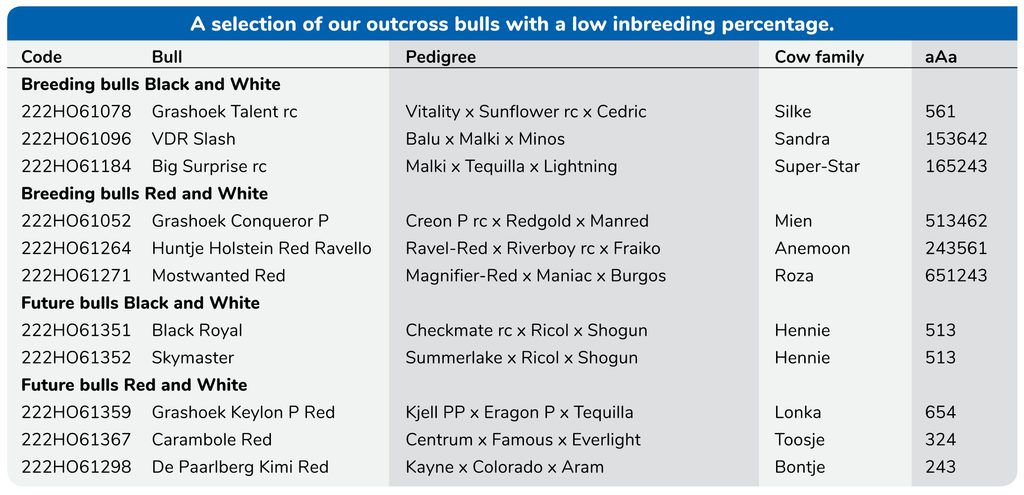
A wide range of bloodlines!
K.I. Samen ensures that there are enough outcross sires in the range, in both the black-and-white and red-and-white segments. What will you do? Will you choose an outcross sire for the next cow in heat?
